The History Behind London's Famous Bridges
 This photo was taken by Thomas K on Pexels.
The Medieval Origins: London Bridge's Ancient Legacy
Stepping onto the site of London Bridge today, one can almost feel the weight of nearly two millennia of history beneath their feet, a legacy that began in Roman times when the first timber structure was erected to connect the bustling port of Londinium to the south bank. For centuries, this crossing served as the vital artery of the city, enduring fires, floods, and political upheavals, but it was during the medieval period that the bridge truly evolved into a fortified town in its own right. The famous medieval stone bridge, constructed between 1176 and 1209 under the direction of Peter de Colechurch, was not merely a passageway but a vibrant community lined with shops, houses, and even a chapel dedicated to St Thomas Becket, creating a narrow, crowded thoroughfare that defined the character of London for over six hundred years.
The ancient legacy of this medieval marvel is often overshadowed by later iterations, yet its influence on London's development cannot be overstated; it stood as the only fixed crossing over the River Thames until the nineteenth century, making it the focal point of commerce, defense, and public spectacle. Legends abound regarding its construction, including tales of a cursed foundation requiring the sacrifice of a child, which added an air of mystique to its towering arches that once supported a gatehouse capable of repelling invaders. Although the original medieval structure eventually crumbled under the strain of traffic and decay, leading to its replacement in the 19th century, the spirit of those ancient days remains embedded in the city's narrative, reminding visitors that every step taken here traces back to the foundational stones laid by our ancestors.
 This photo was taken by Erik Mclean on Pexels.
Engineering Marvels: The Rise of Tower Bridge
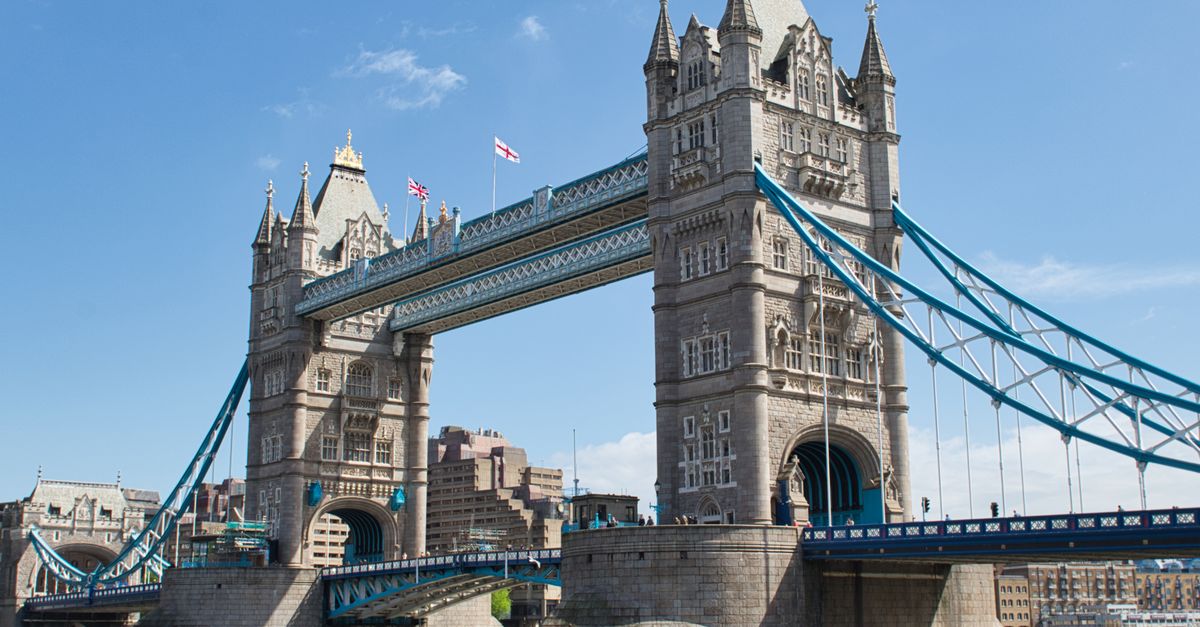
Rising majestically over the River Thames, Tower Bridge stands as a testament to Victorian ingenuity and the industrial ambition of late 19th-century London. Conceived to solve the critical problem of allowing heavy river traffic to access the East India Docks while maintaining a vital road link across the city, this iconic structure took eight years to complete, finally opening in 1894. Unlike its neighbor, the ancient London Bridge, which is a simple stone crossing, Tower Bridge is a combined bascule and suspension bridge that offers a unique engineering solution; its two massive towers are connected at the upper level by walkways and at the lower level by two enormous leaves that can be raised to let tall ships pass through, a feat that still mesmerizes visitors today.
The bridge's construction was a monumental undertaking that required innovative techniques and immense resources, utilizing over 70 million bricks and 250 tons of steel to create a structure that is both functional and aesthetically stunning. Its distinctive blue and white color scheme, originally chosen for camouflage against the smog of the era, has become synonymous with the London skyline, while the internal engine rooms, now a museum, house the original hydraulic machinery that powered the lifting mechanism before being electrified in the mid-20th century. For tourists exploring the history of London's bridges, Tower Bridge represents not just a crossing point, but a triumph of human engineering that seamlessly blends Gothic Revival architecture with the raw power of the Industrial Revolution, ensuring its place as one of the world's most photographed landmarks.
 This photo was taken by Muharrem Alper on Pexels.
From Iron to Glass: The Evolution of Millennium Bridge
When the Millennium Bridge first opened its doors in 2000, it shattered traditional expectations of London's river crossings by replacing heavy iron and stone with a sleek, modern design of steel and glass. Unlike the historic structures that dominate the Thames skyline, this pedestrian-only span was conceived as a minimalist masterpiece, utilizing a unique "wobble" mechanism to allow for a seamless flow of foot traffic without the rigid constraints of older engineering. The bridge's initial construction relied heavily on a revolutionary use of tensioned steel cables and a slender deck, symbolizing the city's leap into the new millennium with a structure that appeared almost weightless against the backdrop of St Paul's Cathedral.
However, the evolution of the Millennium Bridge is also a story of rapid adaptation and resilience, famously triggered by an unexpected swaying motion experienced by thousands of pedestrians on its opening day. In response to this structural instability, engineers swiftly returned to the drawing board, installing over 370 tuned mass dampers hidden within the bridge's supports to absorb kinetic energy and eliminate the oscillation. This critical retrofit transformed the bridge from a controversial experiment back into a stable icon, proving that even the most contemporary designs must respect the dynamic forces of nature while maintaining their elegant, transparent aesthetic for future generations to enjoy.
 This photo was taken by Abdullah Öğük on Pexels.